Britain, Nasser and the Balance of Power in the Middle East, 1952-1977: From the Eygptian Revolution to the Six Day War by Robert McNamara
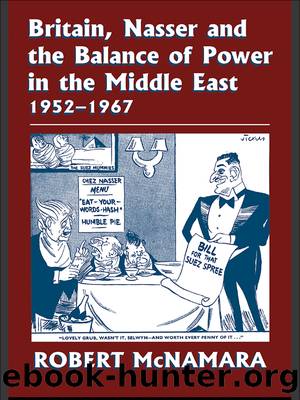
Author:Robert McNamara [McNamara, Robert]
Language: eng
Format: epub
Tags: History, Middle East, General, Political Science, International Relations, Security (National & International)
ISBN: 9780714653976
Google: JdqImAEACAAJ
Goodreads: 444094
Publisher: Routledge
Published: 2003-01-15T06:48:34+00:00
THE PATH TO THE ANGLO-EGYPTIAN DÃTENTE
The change in policy in the Middle East coincided with a breakthrough in the Anglo-Egyptian talks. Once the issue had come down to the value of the lump sum that Egypt was to pay Britain for Egyptianised property, the question became a matter of which side would compromise first on the war damage claim. On 19 December 1958âthanks to the intervention of Eugene Black- a draft agreement was initialled. On 4 January 1959, a figure of £27.5 million was agreed as the value of the lump sum that Egypt would pay Britain for Egyptianised property. The final nuances of the deal were to be worked out in Cairo. The British also felt that they had got guarantees that the British men (Zarb and Swinburn) imprisoned for espionage would be released. The Egyptians had agreed to increase their offer after the British allowed a drawing on the sterling balances to pay for the instalment due on the purchase price of the Suez Canal Company in January Black returned to Cairo on 1 January. He made considerable progress and requested that a delegation be sent to Cairo. Macmillan was unhappy about the British having to travel to Cairo. He confided, in his diary, his reticence: âI do not want our men to go to Cairo unless there is a very fair chance of a settlement. In many respects, I do not like them going to Cairo at all. Discussions in Rome are more dignified.â25
The British delegation arrived on 10 January. Besides the financial issue, the British delegation was to seek the release of the two British prisoners and to get diplomatic relations restored at charge dâaffaires level.26 The agreement was initialled on 22 January. However, disagreements immediately arose over the status of the British diplomatic mission, which was needed to oversee the agreement, and the status of the Smouha estate outside Cairo. The Egyptians claimed the land was agricultural and therefore was to be Egyptianised while the British and Smouha family believed that the land was development land and should be desequestrated. The conflicting interpretations of the value of the land had the potential to upset the deal as, if the British had to pay Smouha compensation for development land, the £27.5 million would be completely inadequate. Macmillan feared that the talks were going to fail. His diary entry though is surprisingly empathetic with Nasser: âThe Egyptian treaty is hanging fire and may go sour altogether ⦠I hope this is a genuine misunderstanding and can be cleared up. But I fear that Nasser may have got âcold feetâ and shrinks from rebuilding his bridges with the UK even to get £46 Million. He too, I have no doubt, has his âSuez Groupâ!â27
The Smouha case favoured the Egyptians as it turned out. The greater problem remained the question of diplomatic relations. The British had entered the agreement primarily to get these restored. However, the anti-British element in Cairo had Nasserâs fear. Even the subject of diplomatic immunities
Download
This site does not store any files on its server. We only index and link to content provided by other sites. Please contact the content providers to delete copyright contents if any and email us, we'll remove relevant links or contents immediately.
| Anthropology | Archaeology |
| Philosophy | Politics & Government |
| Social Sciences | Sociology |
| Women's Studies |
The Secret History by Donna Tartt(19090)
The Social Justice Warrior Handbook by Lisa De Pasquale(12190)
Thirteen Reasons Why by Jay Asher(8910)
This Is How You Lose Her by Junot Diaz(6887)
Weapons of Math Destruction by Cathy O'Neil(6281)
Zero to One by Peter Thiel(5802)
Beartown by Fredrik Backman(5755)
The Myth of the Strong Leader by Archie Brown(5508)
The Fire Next Time by James Baldwin(5446)
How Democracies Die by Steven Levitsky & Daniel Ziblatt(5219)
Promise Me, Dad by Joe Biden(5153)
Stone's Rules by Roger Stone(5088)
A Higher Loyalty: Truth, Lies, and Leadership by James Comey(4964)
100 Deadly Skills by Clint Emerson(4926)
Rise and Kill First by Ronen Bergman(4789)
Secrecy World by Jake Bernstein(4753)
The David Icke Guide to the Global Conspiracy (and how to end it) by David Icke(4720)
The Farm by Tom Rob Smith(4514)
The Doomsday Machine by Daniel Ellsberg(4490)
